


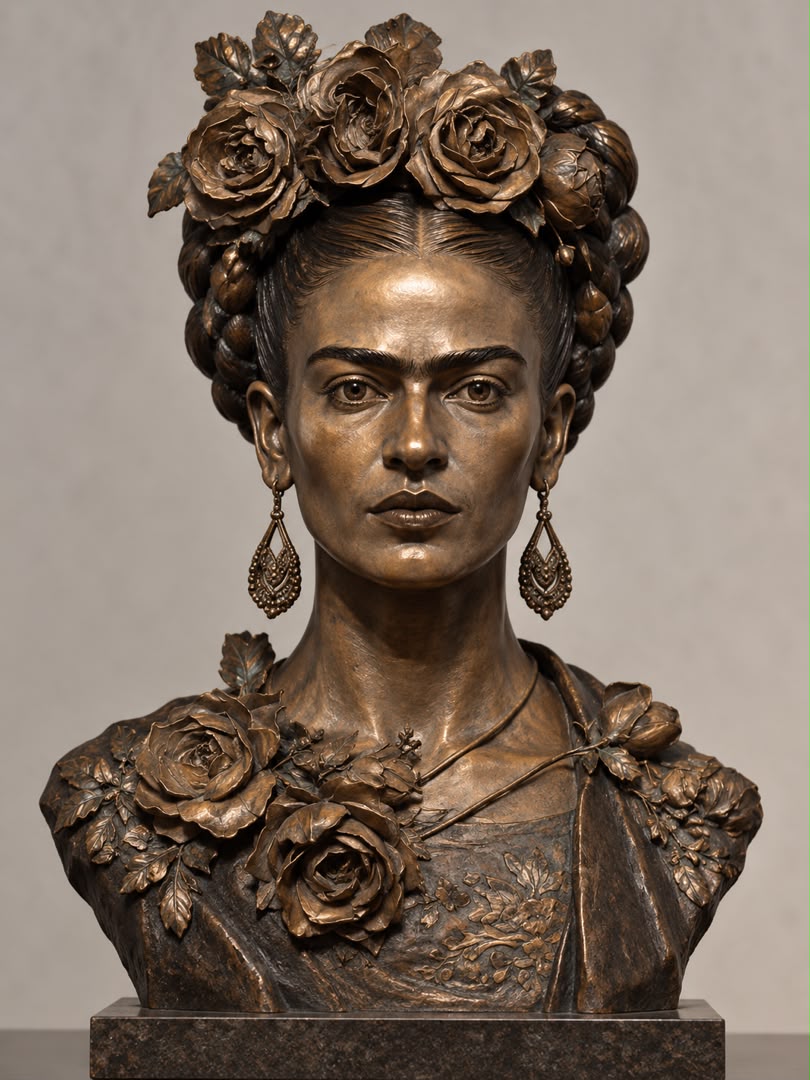
An introduction to Bespoke Bronze — commissioned statues and busts, launching soon at Fountain Store
There is a moment that happens in almost every family. A box comes down from a cupboard, and inside it are photographs of someone who is no longer here. Everyone leans in. Someone says, that's exactly how he stood. And then the box goes back on the shelf for another few years.
Photographs are precious. But they are flat, they fade, and they live in drawers. For more than three thousand years, when people have wanted to say this person mattered, and I want that to be obvious to anyone who walks into this room — they have reached for bronze.
We think that instinct deserves to be available to more than museums and municipalities. Which is why we are preparing to launch Bespoke Bronze: commissioned statues and busts, sculpted from your own photographs and video, made to order in any size.
The technique has barely changed. Lost-wax casting — cire perdue — is the process by which a sculpture is reproduced in metal from an original model, and the oldest known examples come from the Indus Valley, dating back nearly 5,000 years (lost-wax casting, art history reference).
By the time the Greeks were producing their masterpieces, the method was already ancient. The Riace Bronzes — two slightly-larger-than-life warriors cast around 460–450 BCE and recovered from the sea off Calabria in 1972 — were made using lost-wax casting, a process already old when they were made (Riace bronzes, Quiet Canvas). They spent roughly two thousand four hundred years underwater. They are still magnificent.
Our commissions are made the same way. Not because we are sentimental about tradition, but because nothing better has been invented.
Portraiture began as remembrance
It is worth knowing where the portrait bust actually comes from, because it was never about vanity first.
The Roman practice of making busts grew out of death masks taken from family members (Roman portrait sculpture). The imagines maiorum — likenesses of ancestors — were carried at funerals, walking ahead of the bier and sitting in the Forum during the public eulogy, a visible testament to the family's standing and continuity.
A bust was how a family said: these are the people we come from.
Centuries later, the same object was doing similar work in English country houses, where bust portraiture became central to how families presented themselves and their place in a longer story
The impulse has not changed. Only the access has.
What bronze actually gives you
Bronze is the reason any of this survives.
It is an alloy of copper and tin, and its great gift is the patina — that green, blue and brown surface that forms as the metal reacts slowly with air and moisture. Patina is not dirt and not decay. It is a thin protective layer of controlled oxidation that shields the metal beneath.
The practical result: a properly cast and maintained bronze can realistically last 100 to 500 years outdoors, and centuries longer in sheltered conditions (Relong Sculpture). Indoors, a thousand years or more with minimal care (Landtop). How long any individual piece lasts comes down to three things: the quality of the casting, where it is placed, and how it is looked after (Bronzes Gallery).
Two of those three are our responsibility. That is not a small thing to take on, and it is why we have been slow and careful in bringing this category to market.
Patina is also a choice. Ferric nitrate produces browns and blacks; liver of sulphur gives browns through to greens and blues; cupric salts yield blues, greens and reds (patina chemistry). Applied hot or cold, by hand, by someone who has done it a thousand times. Your finish is a decision, not a default.
Occasions people commission for
We have spent a long time listening to why customers ask about this work. The reasons cluster more tightly than you might expect.
To honour a life. A parent, a grandparent, a partner. Often commissioned in the year after a loss, when a family is looking for something more substantial than a plaque.
To mark an achievement that took decades. A retirement after forty years in a trade. A business handed to a second generation. A doctorate finished late in life against the odds.
To celebrate a beginning. The birth of a first child or a first grandchild. Some families commission at birth and keep the piece for the child's twenty-first.
To recognise someone outside the family. A mentor. A coach. A founder. A long-serving colleague who quietly held an organisation together.
For the ones who greeted you at the door. Pets are among the most requested commissions, and we would never treat them as lesser work.
For community. Clubs, schools, temples, churches, RSLs, cultural associations and local councils marking their own histories and their own people.
Eulogy in permanent form. Words said once, at a funeral, given a shape that stays in the house.
A new category is easy to announce and harder to earn. Here is what we are holding ourselves to.
Premium standing, honestly priced. Commissions start from $2,200 excluding GST and freight for a bust of approximately 50–65 cm. Every piece is individually quoted, because size, complexity and material genuinely change the cost. We will not quote a number we cannot stand behind, and we will tell you when an idea is not achievable within your budget rather than taking the deposit and hoping.
You see it before it is set in metal. Around 8–10 days after your brief, we present a clay maquette. Two full rounds of revisions are included. Change the expression. Change the tilt of the head. Involve the whole family and argue about it. This is the stage where a likeness becomes right, and we would far rather spend time here than deliver something that is merely close.
Materials chosen for longevity, sourced responsibly. Bronze is among the most genuinely recyclable materials in sculpture — copper and tin can be melted down and given new life repeatedly, and reclaimed copper is widely used in contemporary casting (sustainability in bronze sculpture). Modern silicon bronze also effectively eliminates the heavy metals present in historical alloys, limiting lead content to negligible levels (the ethics of contemporary bronze). We work with foundries that use recycled bronze where possible and that can tell us, on request, where their material came from.
Craft properly paid for. Hand-sculpting, hand-chasing and hand-patination are skilled work performed by people. We price so that the artisans doing it are paid properly. A commission that seems suspiciously cheap is usually cheap because someone in the chain was not.
Championing art, in all its forms
We sell fountains, statues, basins and tiles. Across that catalogue we have come to believe something fairly simple: there is no single tradition that owns beauty.
Our range already draws on Andalusian courtyards and Moorish tilework, on classical European carving, on Asian sculptural traditions, on the Mediterranean and on contemporary Australian design. A zellige fountain and a Renaissance marble pond can share a garden. A Buddha and a family bust can share a hallway. We have never seen a reason to rank these against each other.
So when you commission a piece from us, we will sculpt whoever you ask us to sculpt, however you ask us to represent them. Any face. Any faith. Any family shape. Any cultural tradition of dress, posture, adornment or symbolism — and we will ask questions rather than assume, because getting a cultural detail wrong on a memorial is not a small error.
On community. Our best work has always come through local relationships — with landscapers, designers, stonemasons, trades and the customers who send us photographs of their finished gardens years later. For this category we are actively interested in working with community organisations, clubs, schools and cultural associations on tribute and commemorative pieces, including at scales that are not commercially obvious for us. If you are a group trying to honour someone and the budget is tight, talk to us anyway.
Bespoke Bronze opens shortly. The process is deliberately unhurried:
1. Send photographs, video and a short brief, and confirm your preferred size
2. We provide a written quotation based on your chosen material and dimensions
3. A 30% deposit confirms your commission and schedules production
4. Concept sketch
5. Clay maquette at 8–10 days — two rounds of revisions included
6. Final approval locks the design
7. Casting and hand-finishing, approximately two weeks
8. Crated, insured and delivered
Typical turnaround: 4–6 weeks. You may also elect to include an inscribed message, depending on the design chosen — a name, a date, a dedication, or a few words in your own voice.
Register your interest now and we will contact you when commissions open, along with a guide to photographing a subject well.
sales@fountainstore.com.au - 1300 848 094
Bespoke Bronze commissions are individually sculpted to each customer's specification. Full terms, including revision rounds, deposit and returns, are set out on the collection page.


